Checking whether AI recommendations hold when your target customer asks
This article follows our November 4 update, Piloting checks on where AI recommendations diverge by customer profile. Our November 2 update, Showing AI's clarifying questions before it makes recommendations, explains the starting point for this work.
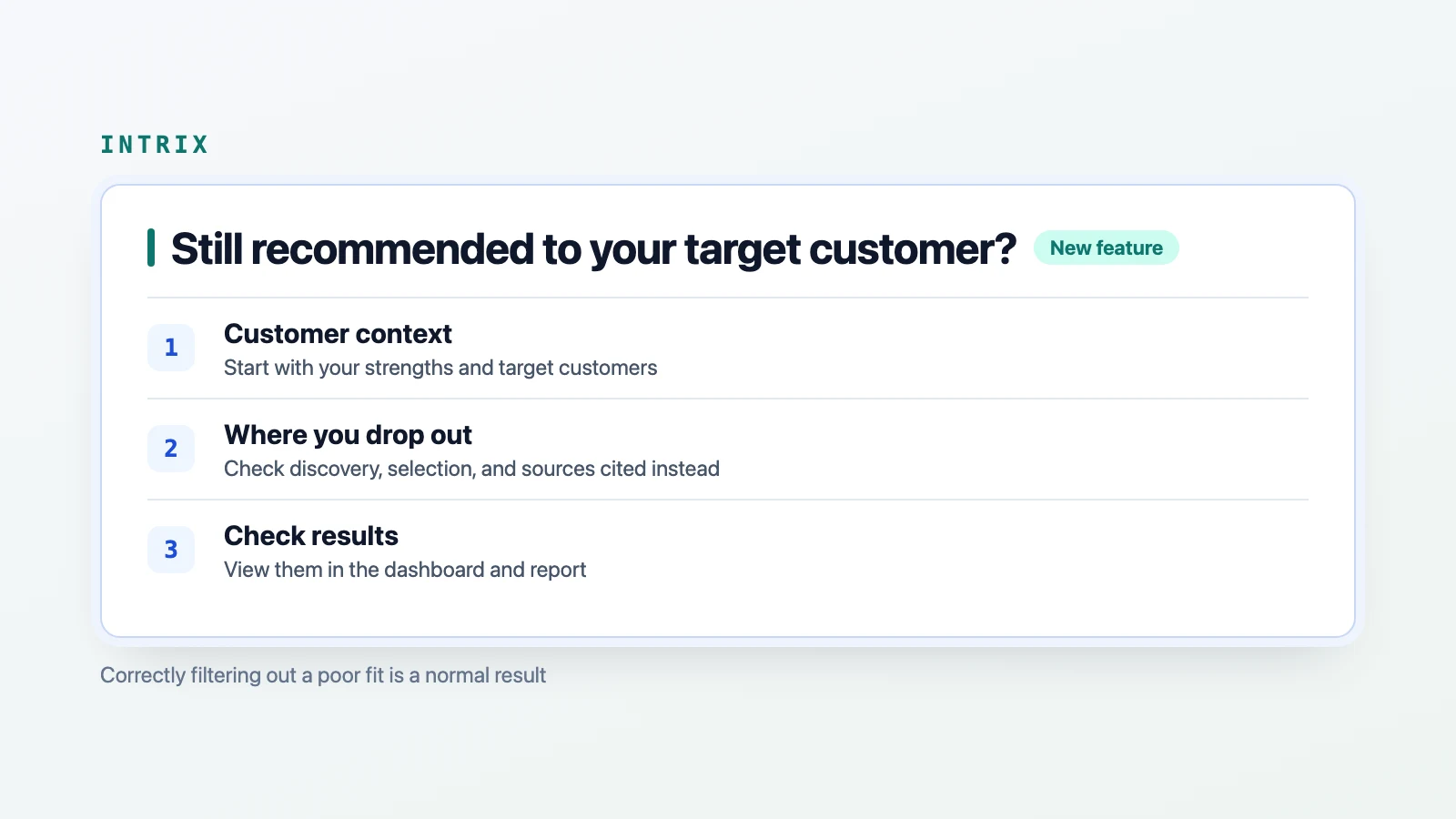
Intrix is revising the customer profile AI conversation checks introduced on November 4. The check shows whether a company remains among AI's recommended candidates when the customers it wants to reach explain their circumstances. We have completed the first pilot measurement using questions about Intrix. Clients who have had this check can see their results on the dashboard's assessment settings screen and under “Target Customer Check” in the measurement report. You can preview the screens in the sample dashboard.
We start with the company's target customers instead of waiting for AI to ask
In the previous pilot, clients saw the conditions AI asked about before making recommendations, such as location, industry, and company size. However, across the latest 30 days of measurements, ChatGPT asked for conditions first in only 1.4% to 3.2% of responses, depending on the service tier. For Gemini, the rate was 0% for each of the two models, with no such responses out of 496 for each. If clients wait for AI to ask first, the customer circumstances their company considers relevant may be missing from its recommendations.
The revised check shows results for customer profiles that reflect the company's unique strengths (USP), descriptions of its target customers, what customers have said in consultations and inquiries, and public information on its website. We also show clients the supporting sources for each customer condition.
We checked why customer context should continue in conversation rather than all appear in the first question
Putting all customer circumstances into the first question may seem simpler, but the measurements produced a different result.
Intrix tested 60 questions across four AI systems. Adding specific customer conditions and company strengths changed the intent of the questions: questions about diagnosing causes or setting priorities increased from zero or one to five. However, many of those conditions disappeared when AI rewrote the search query before answering. In the ChatGPT family, roughly half of the question conditions were dropped from the search queries. In the Gemini family, four out of five were dropped, leaving general searches for company recommendations.
The check shows whether the initially recommended companies remain after a customer explains their circumstances in conversation, which companies drop out, and which are newly recommended. It also covers cases where AI already knows the customer's circumstances.
We distinguish exclusion for a poor customer fit from problems with a page
Being recommended to every customer is not always a good result. Alongside the target customers the company wants to reach, we show clients results for customers with different priorities, such as guaranteed top placement within the current month and bulk blog post publishing.
When a company is correctly filtered out for a customer who wants something it does not offer, the result is marked as an unmet condition, with nothing to fix. If the company does meet the condition but is excluded because relevant figures or explanations are missing from its website, or because an old page or external article contains incorrect information, we show clients which improvements to address first.
We narrow down what to fix by finding the dropout stage and replacement sources
If the company drops out of recommendations after customer context is added, we show clients where it was blocked.
- Discovery stage: the company's materials were absent from the sources AI read.
- Selection stage: AI read the company's page but did not cite or mention it in the final answer because it judged the company unsuitable for the customer's conditions.
- Sources cited instead: if the company appeared without conditions but dropped out after customer context was added, we also show clients the competitor pages, external comparison articles, or publications newly cited in that response.
- Checking the reason: we show clients AI's answer explaining why it judged the company unsuitable for the customer's conditions. We also show whether page access was blocked or specific information was missing.
Results that are difficult to judge are marked as “Pending.”
Here is how we show the results in the dashboard and report
Clients who have had this check receive their results on the dashboard's assessment settings screen and under “Target Customer Check” in the measurement report. We provide a one-line conclusion for each customer profile: whether the company remains recommended when that customer asks this way, where it drops out if it does, and which sources are cited instead. When a customer who is a poor fit is filtered out, we mark the result as “Normal.”
The first pilot for Intrix covered three general recommendation questions without conditions, such as “Recommend a GEO agency,” and two tiers of one AI service, with four results for each question at each tier. Intrix appeared among the recommended candidates once out of 24 responses without conditions.
Of the 23 cases where Intrix was absent from the first answer, it was newly added as a candidate in 12 after a marketing decision-maker explained that they were under pressure to adopt GEO but needed evidence to make a decision.
For a customer seeking guaranteed top placement within the current month and bulk blog post publishing, Intrix was never newly recommended in 23 cases. AI said Intrix was not a fit because it does not guarantee visibility or offer a bulk publishing package. This is the desired result: a customer who is a poor fit was correctly filtered out.
This was a first pilot involving one company, one language, and three questions, so we do not generalize these rates.
To discuss a target customer check, contact Intrix
Explore Intrix
More updates
Checking How AI Introduces, Compares, and Cites Your Brand Beyond General Industry Questions
Even brands that rarely appear in general industry questions show clear differences in candidate inclusion and mention order when questions shift to selection and comparison. For companies seeking to grow their brands, we offer consultation to check how AI introduces their brand and which sources it uses.
ResearchWe are piloting a connector for ChatGPT and Claude so you no longer need to copy work instructions
Draft website pages and external channel content in ChatGPT or Claude and record publication. Applications for official directory review have been submitted to both platforms.
Coming soonWe are restructuring pricing to compare changes before and after your improvements are complete
We are replacing calendar-based monthly billing with runs deducted when your website improvements are complete. All services use four AI environments with five repetitions, and pricing depends only on the number of questions, in increments of 10.
Service